


How many metres of rod?
Add up the length of every joint or gap. We add 10% for cutting and corners.
1 ft ≈ 0.3 m. A 4 × 5 ft window has about 5.5 m of frame gap. Pick the diameter first – rod about 25% wider than the gap.
- Fills gaps before sealant
- Saves silicone & PU sealant
- 8 to 50 mm diameters
- 3 m to 100 m rolls
- Cuts with scissors
- Prepaid · free delivery
Which diameter for your gap?
Measure the gap width – rod about 25% wider. Tap your job.
 Window & door frame gaps (6–8 mm)
10 mm × 10 m
Snug in a narrow frame gap; one roll does about two windows.
Shop this →
 Brick–column & wall gaps (12–16 mm)
20 mm × 10 m
Our most-stocked size for masonry joints.
Shop this →
 Floor expansion joints (20–24 mm)
30 mm × 10 m
Fills a standard 20–25 mm slab joint before PU sealant.
Shop this →
 Wide podium & parking joints (30–40 mm)
40 mm × 10 m
For wide joints between large slabs and structures.
Shop this →
Choose diameter and roll
8–30 mm on the gap-filler listing, up to 50 mm on the expansion-joint listing – switch above.


Drag to compare
Why joint sealant sinks and tears
Sealant poured into a deep joint with nothing behind it sinks, uses three times the tubes and sticks to the bottom as well as the sides. When the slabs move, it tears.
Push in a backer rod first. The sealant now sits at the right shallow depth, bonds only to the two faces and stretches with the joint.
Rod first, sealant second
Three steps to a joint that doesn't sink or tear.

Pick & press in
Choose a rod about 25% wider than the gap and press it in by hand.
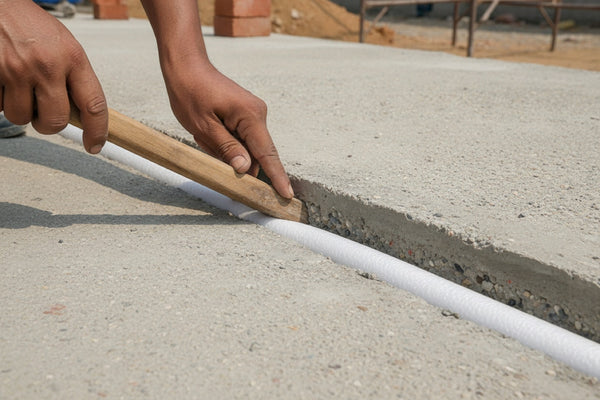
Set the depth
Push it evenly with a blunt stick. Leave space for sealant – about half the joint width.

Seal over it
Run silicone or PU sealant over the rod and tool it smooth.

Backer rod: common mistakes
MythBacker rod is the waterproofing.
FactIt is the backing. The sealant on top makes the joint watertight – the rod sets its depth and saves material.
MythFill the whole joint with sealant – more is stronger.
FactDeep sealant is wasted and tears when the joint moves. About half the joint width deep is right.
MythBuy a rod the same size as the gap.
FactBuy about 25% wider so it grips the sides and doesn't fall in or float up.
MythRope, cloth or thermocol works the same.
FactRope and cloth soak up water and rot; thermocol crumbles. Foam rod is flexible and doesn't absorb water.
Where it is used
From window frames to parking expansion joints.

Window & door frames
Gap between frame and wall before silicone.

Column–brick joints
Where masonry meets concrete.

Floor expansion joints
Podiums, parking, warehouses.

Driveways & paving
Outdoor joints that see sun and rain.
Backer rod vs the usual shortcuts
| Feature |  Recommended
Foam backer rod + sealant |
 Sealant only (deep fill) |
 Rope / cloth stuffing |
|---|---|---|---|
| Uses less sealant | ✓ | ✕ | ✓ |
| Sealant at the right depth | ✓ | ✕ | Uneven |
| Doesn't soak up water | ✓ | — | ✕ |
| Moves with the joint without tearing | ✓ | ✕ | ✕ |
| Cuts to length with scissors | ✓ | — | ✓ |
Sealing a whole building? Get site pricing
Contractors get special rates on 50 m and 100 m rolls.
- Volume pricing on 10+ rolls
- GST invoice
- Mixed diameters in one order

Product details
Large joints need a bigger rod. This white, compressible foam backer rod comes in 10 to 50 mm diameters for expansion joints in floors and podiums, gaps between concrete and masonry, and wide window-frame gaps.
Push the rod into the joint and apply your sealant on top. The rod sets the sealant depth, saves material and lets the sealant stretch only between the two joint faces – which is what keeps it from tearing.
Where it is used
- Expansion joints in floors, podiums, parking and driveways
- Concrete-to-masonry and column-to-wall gaps
- Window and door frame gaps
- Exterior pavements and precast joints
How to install
- Clean and dry the joint.
- Pick a rod about 25% wider than the gap.
- Press it in evenly with a blunt tool – don't puncture it.
- Apply sealant over the rod and tool it smooth.
| Brand | BuildingShop |
|---|---|
| Material | Flexible, compressible foam |
| Colour | White |
| Diameters | 10, 20, 30, 40, 50 mm |
| Lengths | 5, 10, 25, 50 m (varies by diameter) |
| Use | Backing for joint sealants; gap filling |
| Sizing guide | Rod about 25% wider than the gap |
| Model | TP01 |
Which diameter do I need?
Measure the gap width and pick a rod about 25% wider so it fits snugly. Guide: 6–8 mm gap → 8 or 10 mm rod; 12–16 mm gap → 20 mm rod; 20–24 mm gap → 30 mm rod; 30–32 mm gap → 40 mm rod; 40 mm gap → 50 mm rod.
Is backer rod itself waterproof? Can I use it without sealant?
The foam does not soak up water, but it is not a seal on its own. Push it in, then apply silicone or PU sealant over it. The rod controls the sealant depth and stops it sticking to the bottom of the joint.
How deep should I push it?
Leave space for the sealant above the rod – roughly half the joint width (for example about 10 mm of sealant in a 20 mm joint). Use a blunt stick so you don't puncture the foam.
How much length do I need?
Add up the length of every joint and add 10% for cutting. Use the calculator on this page – it shows the rolls for your length.
Can it fill a wall crack before plaster or putty?
For wide gaps around frames, columns and between brick and concrete, yes – fill with rod, then seal. Hairline plaster cracks need crack filler or fibre mesh, not rod.
How do I pay? Is cash on delivery available?
Prepaid only – UPI, debit/credit cards and net banking. Cash on delivery is not available. Prices on BuildingShop are kept lower than on marketplaces.
How long does delivery take?
Delivery is free across India and usually takes 3–7 working days.
Free delivery across India. Most orders reach you in 3–7 working days, depending on your pincode.
Payment: prepaid only – UPI, debit/credit cards and net banking. Cash on delivery is not available.
Bulk or GST invoice? Message us on WhatsApp before ordering.
Finish the joint
Sealant on top, foam for big voids, tape for roof joints.


Customers also viewed

Backer Rod 10 mm White – Expansion Joint Filler Foam Rod for Concrete, Window & Wall Gaps
From
Sale price
Rs. 139
Regular price
Rs. 329


